How to Take Body Measurements: Men & Women Guide
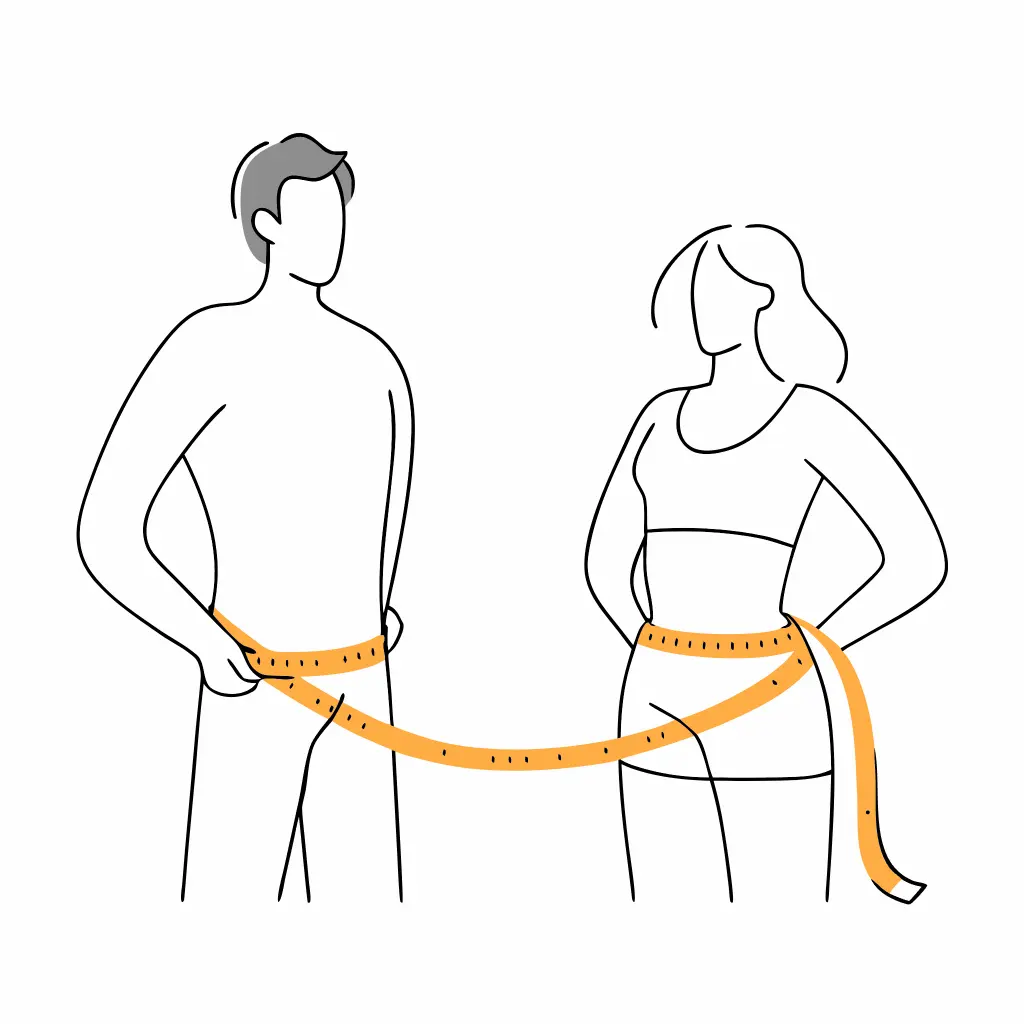
Key Takeaways
- A tape measure tells you things a scale can’t: where you store fat, and whether you’re gaining muscle while losing fat.
- The waist is the most useful health measurement. Hips, neck, height and weight add context. Chest, arms, thighs and calves are mainly for tracking body shape and fitness.
- Consistency beats precision. Same time of day, same landmarks, same tape, same person measuring if possible.
- Measure every 2–4 weeks, not daily. Real changes in body shape are slow.
- Men and women use mostly the same sites, with key differences at the chest/bust, waist and hips.
Why Measure Your Body at All?
Most people track their health with one number: body weight. But weight lumps together fat, muscle, bone, water and whatever you ate yesterday. Two people can weigh exactly the same and have very different health profiles, depending on where their body stores fat.
Body measurements fill that gap:
- Health insight. Your waist circumference is closely linked to abdominal (visceral) fat, the fat most associated with type 2 diabetes and heart disease. It’s the basis of the Body Roundness Index (BRI).
- Progress the scale misses. If you’re exercising, you may lose fat from your waist while adding muscle to your arms and legs. Your weight may barely move while your shape changes noticeably.
- Body awareness. Regular, neutral measurement helps you understand your body’s natural fluctuations, such as bloating, the menstrual cycle and time of day, so a single number doesn’t define your mood.
What You Need
- A flexible, non-stretch tape measure. A sewing tape or a self-retracting body tape both work.
- A full-length mirror, to check that the tape is level.
- A helper, if possible. Hips, chest and upper back are much easier with a second pair of hands.
- A metal tape measure, a flat wall and a hardcover book, for height.
- A digital scale on a hard floor, for weight.
- A notebook, spreadsheet or app to record everything.
The General Rules (Apply to Every Measurement)
- Measure on bare skin or thin, close-fitting underwear.
- Measure in the morning, after using the toilet and before eating.
- Stand relaxed and upright, feet together, weight evenly spread, arms by your sides unless instructed otherwise.
- Keep the tape level and parallel to the floor for circumferences around the torso and limbs.
- Snug, not tight. The tape should rest on the skin without making an indent.
- Breathe normally. For torso measurements, read the tape at the end of a relaxed breath out.
- Measure twice and average. If the two readings differ by more than 1 cm, take a third.
- Measure the same side for limbs. The right side is the research convention.
- Write down the landmark you used, not just the number.
The Health Measurements
These are the measurements with the strongest link to health risk. If you only take a few, take these.
Waist
Where: the midpoint between your lowest rib and the top of your hip bone (WHO/NICE method), or at the top of your hip bone (NIH method).
How: wrap the tape horizontally around that level and read it at the end of a normal breath out, without pulling in your stomach.
Waist is the single most important body measurement for health. It’s also the most commonly mis-measured: the different “waist” sites can differ by up to about 10 cm in women. Our dedicated guide covers both methods, the differences between men and women, and the mistakes to avoid: How to Measure Waist Circumference Correctly.
Hips
Where: the widest part of the buttocks, viewed from the side.
How: stand with your feet together and glutes relaxed, and keep the tape level all the way around.
Hips are used for waist-to-hip ratio, which describes “apple” versus “pear” fat distribution. Full instructions and healthy WHR values for men and women: How to Measure Your Hips & Waist-to-Hip Ratio.
Height
Where: barefoot, back against a flat wall, eyes looking straight ahead.
How: lower a book flat onto the crown of your head, mark the wall, and measure from the floor.
You’re about 1.5 cm taller in the morning than in the afternoon, so timing matters. Full guide, including how to measure alone: How to Measure Your Height Accurately at Home.
Weight
When: in the morning, after using the toilet, before eating, in minimal clothing.
How: use the same scale, on a hard, level floor.
Daily fluctuations of 0.5–2 kg are normal. Full guide, including how the menstrual cycle affects weight: How to Weigh Yourself Accurately.
Neck
Where: just below the larynx (Adam’s apple), with the tape perpendicular to the neck.
How: look straight ahead, keep your shoulders relaxed, and don’t compress the skin.
Neck circumference is used in the US Navy body fat equation and is a screening marker for obstructive sleep apnea. Full guide: How to Measure Body Fat With a Tape Measure.
The Body Shape & Progress Measurements
These are mostly useful for tracking changes from training or weight loss, and for clothing sizes.
Chest (men)
- Stand upright with your arms relaxed at your sides. Raise them slightly while a helper positions the tape, then lower them.
- Place the tape around the fullest part of the chest, typically at nipple level, passing under the armpits and across the shoulder blades at the back.
- Keep it level, and read at the end of a normal breath out. Don’t puff out your chest.
Bust and underbust (women)
Women typically take two measurements:
- Bust: around the fullest part of the breasts, usually across the nipples, with the tape level across the back. Wear a non-padded, well-fitting bra, or none, and be consistent.
- Underbust: directly beneath the breasts, where a bra band sits. Pull the tape snugly, and read after a breath out.
For progress tracking, the underbust measurement reflects changes in the ribcage area and is less affected by breast tissue changes across the menstrual cycle. Bust size can vary over the cycle, so compare readings from the same cycle phase.
Upper arm
- Let your arm hang relaxed by your side.
- Find the midpoint between the bony tip of your shoulder and the tip of your elbow. Mark it if you can.
- Wrap the tape horizontally around the arm at that point, without flexing.
This relaxed-arm midpoint is close to the site used in research protocols such as ISAK, which marks the midpoint between two bony landmarks of the shoulder and elbow.[1] Flexed measurements are popular in gyms but much harder to reproduce. If you do take one, record it separately and always flex the same way.
Thigh
- Stand with your feet slightly apart and weight evenly on both legs.
- Measure around the fullest part of the upper thigh, just below the buttock crease, or at the mid-thigh, halfway between the crease at the top of your leg and the top of the kneecap.
- Keep the tape horizontal, and use the same side each time.
Mid-thigh is easier to find again from session to session. The upper thigh captures more of the area where women commonly store fat.
Calf
- Stand with your feet about hip-width apart and your weight even.
- Find the widest part of the calf by sliding the tape up and down. Record the largest reading.
Calf circumference is used in some clinical screenings of muscle mass in older adults, so it’s useful beyond the gym.
Measuring: Men vs Women at a Glance
| Measurement | Men | Women |
|---|---|---|
| Chest | Fullest part, nipple level | Bust (fullest part) + underbust |
| Waist | Sites usually close together; watch the tape slipping under the belly | Sites can differ by up to ~10 cm; choose one and record it |
| Hips | Widest point is often lower than expected | Find the true maximum: buttocks, hips or upper thigh |
| Neck | Just below the Adam’s apple | Just below the larynx (often less visible) |
| Timing | Avoid weekend/salt spikes | Compare at the same menstrual-cycle phase |
| Health thresholds (WHO waist) | Increased risk ≥94 cm, substantially ≥102 cm | Increased risk ≥80 cm, substantially ≥88 cm |
WHO waist thresholds from the 2008 expert consultation.[2]
Building a Measurement Routine
A routine you’ll keep up beats a perfect one you abandon.
Every 2–4 weeks, on the same morning:
- Use the toilet, then weigh yourself.
- Measure your waist (twice).
- Measure your hips (twice).
- Optional: neck, chest/bust, upper arm, thigh, calf.
- Record everything with the date and landmark notes.
Once or twice a year: re-measure your height.
A simple tracking template
| Date | Weight | Waist (site) | Hips | Neck | Chest/Bust | Arm (R) | Thigh (R) | Calf (R) | Notes |
|---|---|---|---|---|---|---|---|---|---|
| 1 Mar | 72.4 kg | 84.0 cm (midpoint) | 99.5 cm | 34.0 cm | 92.0 cm | 29.5 cm | 56.0 cm | 37.0 cm | Day 8 of cycle |
Copy it into a spreadsheet and add a row each session. After three or four months, the trends become clear.
Turning numbers into insights
- Waist + height → Body Roundness Index and waist-to-height ratio
- Weight + height → BMI
- Waist + hips → waist-to-hip ratio
- Neck + waist (+ hips for women) + height → estimated body fat %
Our BRI and BMI calculator handles the first two in one step.
Measuring Without Obsessing
Body measurements are a tool, not a judgment. A few guidelines keep them helpful:
- Expect noise. A centimetre up or down between sessions is often bloating, posture or tape placement, not real change.
- Look at months, not days.
- Measure less often if it causes distress. If tracking leads to anxiety, compulsive checking or restrictive eating, step back and speak to a healthcare professional.
- Numbers are context, not a diagnosis. If a measurement concerns you, especially a waist above the WHO thresholds, discuss it with your doctor.
Frequently Asked Questions
What are the most important body measurements?
For health, waist circumference is the most informative, followed by height and weight (for BMI and BRI) and hips (for waist-to-hip ratio). For fitness, add chest, arms and thighs.
How often should I take body measurements?
Every two to four weeks is enough for most people. Measuring more often mostly captures daily fluctuations.
Should I measure the left or right side?
Research protocols generally use the right side. Either is fine for personal tracking, as long as you always use the same one.
Can I take body measurements by myself?
Yes, for waist, upper arm, thigh, calf and weight. Hips, chest and height are more accurate with a helper, but our individual guides include solo techniques.
Why do my measurements change from day to day?
Food, salt, hydration, digestion, posture and (for women) the menstrual cycle can all shift torso measurements by a centimetre or more. Measuring at the same time and under the same conditions minimises this.
Do body measurements show muscle gain?
Indirectly. Increasing arm, thigh or calf measurements while your waist stays the same or shrinks usually suggests muscle gain and fat loss, even if your weight hasn’t changed.
References
ISAK: International Standards for Anthropometric Assessment. International Society for the Advancement of Kinanthropometry. Mid-acromiale-radiale arm girth landmark.
WHO: Waist circumference and waist–hip ratio: report of a WHO expert consultation, Geneva, 8–11 December 2008. World Health Organization, 2011. who.int
NICE guideline NG246: identifying and assessing overweight, obesity and central adiposity. nice.org.uk
CDC / NCHS: NHANES Anthropometry Procedures Manual. cdc.gov
Measurement Guides in This Series
- How to Measure Waist Circumference Correctly (Men & Women)
- How to Measure Your Hips & Waist-to-Hip Ratio
- How to Measure Your Height Accurately at Home
- How to Weigh Yourself Accurately
- How to Measure Body Fat With a Tape Measure (US Navy Method)
Related Articles
- What Is Body Roundness Index (BRI)?
- BRI vs BMI: Which Is More Accurate?
- How to Lower Your BRI: Evidence-Based Strategies
Use Your Measurements
Start with the two numbers that matter most: your waist and height. Enter them into our free BRI and BMI calculator to see your Body Roundness Index. It runs entirely in your browser, so your measurements never leave your device.