How to Measure Your Waist Correctly (Men & Women)
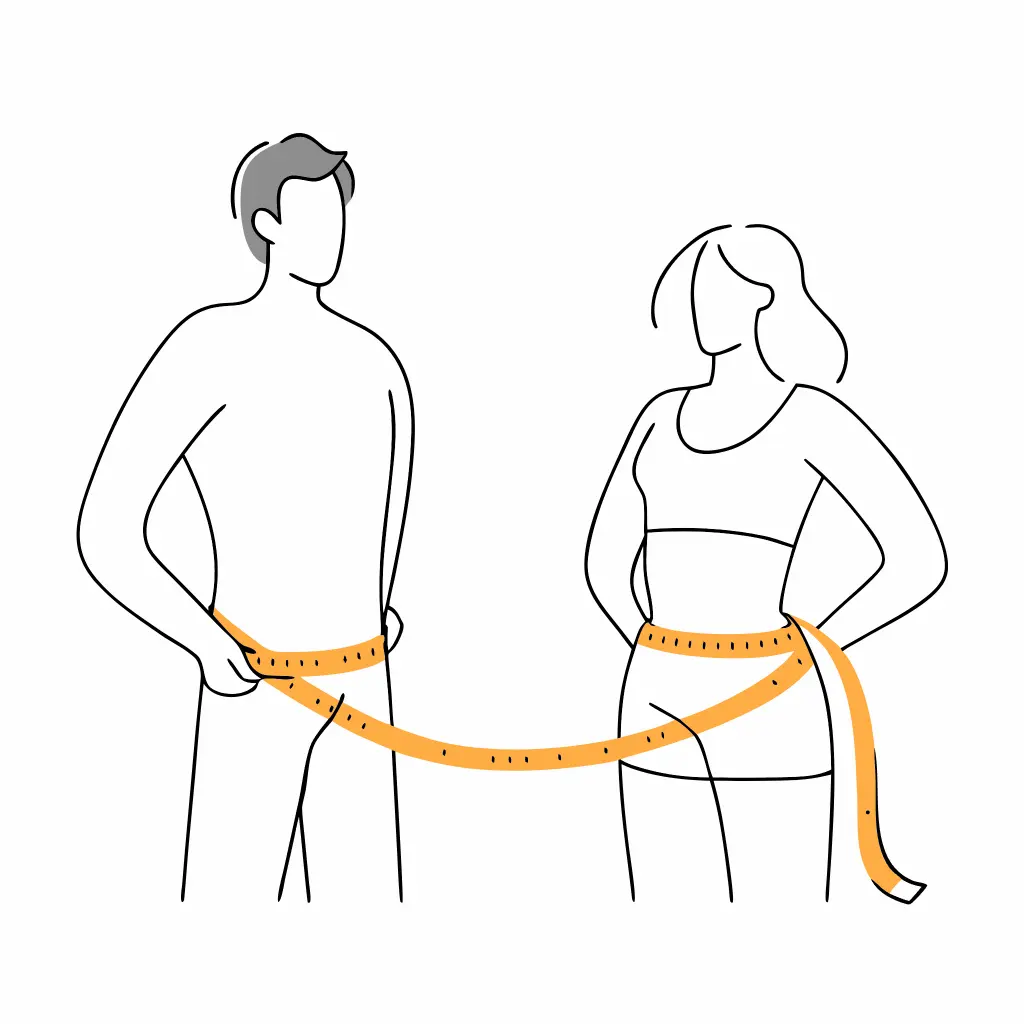
Key Takeaways
- There is no single “waist.” Major health bodies use three different sites. In women, the readings can differ by up to about 10 cm depending on which one you pick.
- The two standard sites are the midpoint between your lowest rib and the top of your hip bone (WHO, NICE) and the top of the hip bone itself (US NIH and the NHANES surveys).
- Measure on bare skin, at the end of a normal breath out, with the tape level all the way around and snug but not pressing in.
- Pick one method and stick to it. For tracking change, consistency matters more than which site you choose.
- Self-measurement is good on average but easy to get wrong individually. In one study, more than half of a high-risk group under-measured themselves into the “low risk” range.
Why Your Waist Measurement Matters
Your waist circumference is the cheapest window into abdominal fat, the fat stored around your organs that is most strongly linked to type 2 diabetes and heart disease. Bathroom scales can’t tell you where your weight sits. A tape measure can.
It is also the main input for several health indexes:
- Body Roundness Index (BRI), which uses waist and height
- Waist-to-height ratio, which NICE now recommends alongside BMI in the UK[1]
- Waist-to-hip ratio, which uses waist and hips
- Tape-based body fat estimates such as the US Navy method
If your waist reading is off by a few centimetres, every one of these numbers inherits the error. That is why the technique deserves five careful minutes.
What You Need
- A flexible, non-stretch tape measure. A tailor’s or sewing tape works. Avoid metal carpentry tapes. Old cloth tapes can stretch over the years, so check yours against a ruler.
- A mirror, so you can check that the tape is level at the back.
- Bare skin or one thin layer. A T-shirt adds roughly 0.5–1 cm. Jeans or a belt make the reading useless.
- A pen or a notes app to record the number straight away.
Some people find a self-retracting body tape easier (the kind with a button lock), because it keeps an even tension when you measure yourself.
The Three Waist Sites (and Which One to Use)
This is the part most guides skip. “Measure your waist” means different things depending on who is asking.
| Site | Where it is | Used by |
|---|---|---|
| Midpoint | Halfway between the lowest rib and the top of the hip bone (iliac crest) | WHO STEPS surveys, NICE (UK)[1][2] |
| Iliac crest | Level with the top of the hip bone at the side of your body | US NIH guidelines, NHANES surveys[3] |
| Narrowest point | The visibly smallest part of the torso | Many fitness and fashion guides |
The navel is not a standard landmark. Measuring “at the belly button” is common, but the navel’s position varies a lot between people and moves with weight change and posture.
How much do the sites differ?
In men the sites usually land within a few centimetres of each other. In women, body shape makes the gaps much larger. In a study of 119 overweight adults, the differences between sites ranged up to about 10 cm in women, compared with a smaller spread in men.[4] Another study in young people found the iliac-crest reading averaged about 4.6 cm larger than the midpoint in females.[5]
That gap is enough to move someone across a risk category. It is the main reason two people can “measure their waist” and get results that aren’t comparable.
Which site should you choose?
- For BRI: the formula was built from US survey data in which waist was measured at the iliac crest, NIH-style.[6] If you want your score to be as comparable as possible with the research, measure at the top of your hip bone.
- For waist-to-height ratio or the WHO/NICE cut-offs: use the midpoint.
- For tracking progress: any site works, provided you use the same one every time and write down which one it was.
Step-by-Step: Measuring at the Midpoint (WHO/NICE Method)
- Stand up straight with your feet about shoulder-width apart and your weight evenly spread. Let your arms hang relaxed at your sides.
- Find your lowest rib. Run your fingers down the side of your ribcage until you feel the bottom edge of the last rib.
- Find the top of your hip bone. Press into your side just below the waist and move down until you hit the upper edge of the pelvis (the iliac crest).
- Mark the midpoint. Halfway between those two points is your measuring site. A washable marker or a strip of tape on each side helps.
- Wrap the tape around your body at that level. In the mirror, check that it sits level at the back. A tape that dips over the lower back is the most common error.
- Breathe normally, and take the reading at the end of a relaxed breath out. Don’t suck in, and don’t push your stomach out.
- Read to the nearest 0.5 cm (or ¼ inch).
- Repeat. Take the tape off, put it back, and measure again. If the two readings are more than 1 cm apart, take a third and average the two closest.
Step-by-Step: Measuring at the Iliac Crest (NIH Method)
- Stand as above.
- With your fingertips, find the highest point of your hip bone on the right side of your body.
- Place the tape just above that point, then bring it around your body level with the floor.
- Read the tape at the end of a normal breath out, without compressing the skin.
- Repeat and average.
The iliac-crest site is often lower than people expect, sometimes below the navel. It feels “wrong” because it isn’t where your trousers sit or where you look narrowest. That’s normal.
Measuring Your Waist: Men vs Women
The technique is the same for both sexes, but a few practical differences change the result.
For men
- The midpoint and the iliac crest are often close together, so the method you choose matters less.
- Men with a large abdomen often let the tape slide down at the front, below the belly, where the torso is narrower. Check in the mirror that the tape stays level.
- Your belt line is not your waist. Many men wear trousers below the abdomen, so trouser size can underestimate waist size by several inches.
- Men tend to store excess fat around the abdomen, so waist size is a particularly strong risk signal for men. WHO risk thresholds start at 94 cm (37 in), with substantially increased risk from 102 cm (40 in).[2]
For women
- Pick your site deliberately and record it. For the reasons above, the readings differ more in women.
- Your menstrual cycle matters. Fluid retention typically peaks around the start of a period, and studies find body weight about 0.45 kg higher during menstruation than in the first week of the cycle, mostly due to extra water.[7] Bloating can add a centimetre or two to the waist. For trend tracking, measure at the same point in your cycle each month.
- Pregnancy and the first months after birth: waist measurements don’t reflect body fat in these periods, and the standard cut-offs don’t apply.
- WHO risk thresholds for women start at 80 cm (31.5 in), with substantially increased risk from 88 cm (34.6 in).[2] If you want BRI specifically, our BRI calculator for women explains how results are read for female bodies.
How Small Errors Change Your Results
Here is why a careful measurement is worth it. Take a man who is 178 cm (5’10”) tall, and run his waist through the BRI formula:
| Waist measured | BRI | Category on our calculator |
|---|---|---|
| 88 cm | 3.25 | Very lean body shape |
| 92 cm | 3.68 | Lean to average body shape |
| 96 cm | 4.13 | Lean to average body shape |
A 4 cm difference, roughly the gap between measuring at the narrowest point and at the hip bone, is enough to cross a category boundary.
For a woman 165 cm (5’5”) tall, here are three plausible readings at different sites:
| Site | Waist | BRI | Waist-to-height ratio |
|---|---|---|---|
| Narrowest point | 74 cm | 2.44 | 0.45 |
| Midpoint | 78 cm | 2.86 | 0.47 |
| Iliac crest | 84 cm | 3.53 | 0.51 |
The last reading crosses the 0.5 waist-to-height threshold that NICE uses to flag increased central adiposity,[1] even though it is the same body on the same morning. This is not a flaw in the indexes. It shows why you should compare like with like.
How Accurate Is Measuring Yourself?
Fairly accurate on average, with an important catch.
A study of 750 people in Annals of Family Medicine compared self-measured waist circumference against trained staff. On average the two matched closely. But among normal-weight women whose technician measurement put them in the high-risk range (above 88 cm), 57% measured themselves low enough to land in the low-risk category.[8] Other research suggests that watching a short demonstration video improves self-measurement more than written instructions alone.[9]
The practical lesson: if your result is near a threshold, re-measure carefully, ideally with someone else holding the tape, before drawing conclusions. If it matters for a medical decision, ask your GP or practice nurse to measure you.
Common Mistakes That Skew Your Reading
- Sucking in your stomach. Even a slight brace can take 2–4 cm off.
- Tape not level. It rises at the front and dips at the back, or the other way round. Use a mirror.
- Pulling too tight. The tape should rest on the skin without making an indent. If it leaves a mark, it was too tight.
- Measuring over clothes. Measure on skin whenever possible.
- Measuring after a big meal or at night. Your waist is typically larger later in the day, after food and drink.
- Switching sites between measurements. This is the most common reason for “mystery” changes in tracked numbers.
- Rounding generously. Write down what the tape says, not what you hoped it would say.
When and How Often to Measure
- Time of day: first thing in the morning, after using the bathroom and before eating or drinking.
- Frequency: every two to four weeks is enough. Real changes in abdominal fat are slow. Daily measurements mostly capture bloating and noise.
- Record: the date, the site, and both readings. A simple spreadsheet or notes app works fine.
If you’re also tracking other sites such as hips, chest and thighs, our complete body measurement guide covers a full routine.
Frequently Asked Questions
Should I measure my waist at the belly button?
Not as a rule. The navel’s position varies between people and moves with weight change, so it isn’t a standard landmark. Use the midpoint between your lowest rib and hip bone, or the top of your hip bone, and stay consistent.
Is waist measurement the same as trouser size?
No. Trouser sizes are vanity-sized by many brands and sit wherever the waistband rests, often below the abdomen in men and at the hip in low-rise styles for women. Your measured waist is usually larger than your trouser size.
Do I measure in centimetres or inches?
Either works, as long as you use the same unit for every measurement in a calculation. Our BRI and BMI calculator accepts both.
Can I measure my waist without a tape measure?
You can wrap a piece of string or a phone charger cable around your waist, mark it, and measure the length against a ruler. It’s less precise, but fine as a first estimate.
How much does my waist change during the day?
It’s common for waist size to rise by a centimetre or more between morning and evening because of food, drink and fluid shifts. That’s why morning measurements are best for tracking.
What’s a healthy waist size?
WHO risk thresholds are below 94 cm (37 in) for men and below 80 cm (31.5 in) for women, though these were derived largely from European populations and lower cut-offs are often recommended for South Asian, Chinese and Japanese adults.[2] A simpler, height-adjusted rule from NICE is to keep your waist below half your height.[1]
References
NICE guideline NG246: Overweight and obesity management, section on identifying and assessing central adiposity. National Institute for Health and Care Excellence. nice.org.uk/guidance/ng246
WHO: Waist circumference and waist–hip ratio: report of a WHO expert consultation, Geneva, 8–11 December 2008. World Health Organization, 2011. who.int
CDC / NCHS: National Health and Nutrition Examination Survey (NHANES) Anthropometry Procedures Manual. cdc.gov
Measurement-site comparison in adults: “Waist circumference measurement sites and their association with visceral and subcutaneous fat and cardiometabolic abnormalities.” PMC10118742
Statistics Canada: “Comparison of waist circumference using the World Health Organization and National Institutes of Health protocols.” Health Reports, 2012. statcan.gc.ca
BRI derivation: Thomas DM, Bredlau C, Bosy-Westphal A, et al. “Relationships between body roundness with body fat and visceral adipose tissue emerging from a new geometrical model.” Obesity. 2013;21(11):2264–2271. PMC3692604
Menstrual cycle and body weight: body weight was 0.45 kg higher during menstruation vs the first week of the cycle, linked to extracellular water. PubMed 37395124
Self-measurement accuracy: study of 750 adults comparing self- and technician-measured waist circumference. Annals of Family Medicine. 2016;14(3):262. annfammed.org
Reliability of self-measured circumferences: “Reliability and criterion validity of self-measured waist, hip, and neck circumferences.” BMC Medical Research Methodology. 2016. PMC4855335
Related Articles
- How to Take Body Measurements: Complete Guide for Men and Women: a full routine for every site
- How to Measure Your Hips and Calculate Waist-to-Hip Ratio: the other half of the WHR equation
- How to Measure Your Height Accurately at Home: the second input BRI needs
- How to Calculate BRI: Step-by-Step Formula Guide: turn your measurements into a score by hand
- Visceral Fat: What It Is and How BRI Measures It: why the waist is the right place to look
Put Your Measurement to Work
Got your number? Enter your waist and height into our free BRI and BMI calculator to see your Body Roundness Index, BMI and what they suggest about your body shape. The calculation runs entirely in your browser, and nothing is stored or sent anywhere.