How to Measure Body Fat With a Tape Measure
Key Takeaways
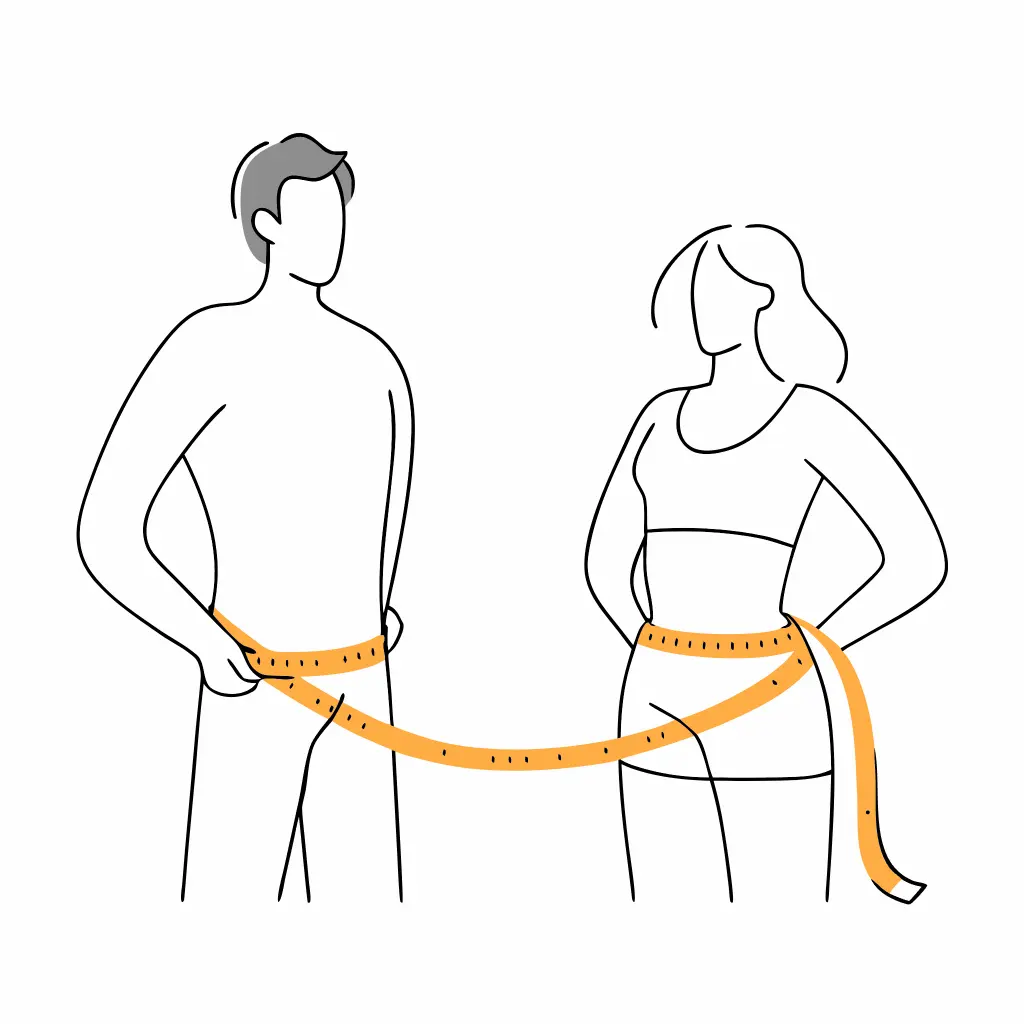
- The US Navy method estimates body fat percentage from tape measurements and height. Men need neck and waist. Women need neck, waist and hips.
- It was developed in 1984 by Hodgdon and Beckett at the Naval Health Research Center and is still one of the most widely used tape-based equations.
- Measuring sites differ by sex. Men measure the waist at the navel. Women measure at the narrowest point and add the hips.
- Accuracy is moderate. The equations tend to overestimate body fat in lean people and underestimate it in people with obesity.
- Use it for trends, not as an exact number, and pair it with a measure of abdominal fat such as BRI.
What the Navy Method Is (and Isn’t)
The idea behind circumference equations is simple. Fat accumulates in predictable places, like the abdomen and hips, while the neck mostly reflects your frame and muscle. Comparing the two, adjusted for height, gives an estimate of body density, which is then converted into a body fat percentage using the Siri equation.[1][2]
The equations were derived by measuring Navy personnel with underwater weighing, then the gold-standard method, and fitting a formula that predicted those results from tape measurements.[1]
What it isn’t: a direct measurement. A DEXA scan, hydrostatic weighing or air-displacement plethysmography (Bod Pod) actually measure body composition. The Navy method predicts it, and for any one person the prediction can be off by several percentage points.
What You Need
- A flexible, non-stretch tape measure
- A mirror, and ideally a helper, especially for neck and hips
- Your measured height (how to measure your height at home)
- A calculator, or the formulas below in a spreadsheet
Measure on bare skin, in the morning, before eating.
How to Measure Your Neck
The neck is the measurement unique to this method, and the easiest one to get wrong.
- Stand or sit upright, looking straight ahead with your shoulders relaxed. Don’t tilt your head up or down.
- Find your larynx (the Adam’s apple in men, often less visible in women).
- Place the tape just below the larynx. Navy guidance specifies bare skin, at the point just below the larynx, with the tape perpendicular to the long axis of the neck, and not over the larynx itself.[3]
- Keep the tape snug against the skin without compressing it. Neck tissue compresses easily, and pulling tight lowers the reading.
- Don’t flare your neck muscles or shrug.
- Read to the nearest 0.5 cm (¼ inch) and repeat.
In this formula, a larger neck lowers your estimated body fat. Pulling the tape tight therefore inflates your result.
What neck size alone can tell you
Neck circumference is also an independent health marker, particularly for obstructive sleep apnea (OSA). The American Academy of Sleep Medicine lists a neck circumference of more than 17 inches (43 cm) in men and more than 16 inches (41 cm) in women as features that may suggest OSA.[4] The STOP-Bang screening questionnaire uses a single cut-off of 40 cm.[5] If your neck is above these values and you snore loudly or feel unrefreshed after sleep, talk to your doctor.
How Men Measure: Neck + Waist
Waist (abdomen) for the Navy formula
The Navy method for men measures the abdomen at the level of the navel, not at the midpoint or the hip bone used in other waist protocols.
- Stand straight, arms relaxed at your sides.
- Place the tape horizontally around your abdomen at the level of the navel.
- Read it at the end of a normal breath out, without sucking in.
- Repeat and average.
The formula for men (all measurements in cm)
Body fat % = 495 ÷ (1.0324 − 0.19077 × log10(waist − neck) + 0.15456 × log10(height)) − 450
Worked example
A man 178 cm tall with a 38 cm neck and a 90 cm waist at the navel:
- waist − neck = 52 → log10(52) = 1.716
- log10(178) = 2.250
- Denominator = 1.0324 − (0.19077 × 1.716) + (0.15456 × 2.250) = 1.0324 − 0.3274 + 0.3478 = 1.0528
- Body fat = 495 ÷ 1.0528 − 450 ≈ 20.2%
How sensitive is that? If the same man’s waist were 92 cm, the estimate rises to about 21.6%. If his neck were measured at 39 cm instead of 38, it drops to about 19.4%. One centimetre on the neck moves the result almost as much as two on the waist, so measure the neck carefully.
How Women Measure: Neck + Waist + Hips
Waist for the Navy formula
For women, the Navy method measures the waist at its narrowest point, usually between the bottom of the ribcage and the navel.
- Stand straight with your arms relaxed.
- Find the visibly narrowest part of your torso in the mirror.
- Wrap the tape horizontally at that level and read it after a normal breath out.
Hips
Measure around the greatest protrusion of the buttocks, as seen from the side, with the tape level with the floor and your feet together.[3] Our hip measurement guide explains the technique in detail.
The formula for women (all measurements in cm)
Body fat % = 495 ÷ (1.29579 − 0.35004 × log10(waist + hips − neck) + 0.22100 × log10(height)) − 450
The original 1984 report gives the same equation in its body-density form: density = −0.350 × log(abdomen + hip − neck) + 0.221 × log(height) + 1.296.[1]
Worked example
A woman 165 cm tall with a 33 cm neck, a 76 cm waist and 98 cm hips:
- waist + hips − neck = 141 → log10(141) = 2.149
- log10(165) = 2.217
- Denominator = 1.29579 − (0.35004 × 2.149) + (0.22100 × 2.217) = 1.29579 − 0.7523 + 0.4900 = 1.0335
- Body fat = 495 ÷ 1.0335 − 450 ≈ 28.9%
If her waist were 78 cm, or her hips 100 cm, the estimate would rise to about 29.9%.
Women-specific considerations
- Your menstrual cycle can temporarily increase waist size through bloating, which raises the estimate. Measure at the same cycle phase each month.
- Shapewear and clothing distort both waist and hip readings. Measure on skin or thin underwear.
- Pregnancy and the postpartum period: the equations don’t apply.
How Accurate Is the Navy Method?
Honestly: reasonable for groups, imprecise for individuals.
- The original women’s equation had a multiple correlation of 0.85 with underwater weighing.[1] That’s a strong relationship, but it still leaves room for meaningful individual error.
- A National Academies review noted that circumference equations overpredict body fat in lean individuals and underpredict it in people with obesity.[2]
- In 2023 the US Army moved from a multi-site tape test (which included the neck and, for women, the hips) to a single abdominal measurement, citing its accuracy compared with the previous multi-site test.[6]
Practical takeaway: the absolute number may be off by several percentage points, but if you measure carefully and consistently, the direction of change over months is meaningful.
Interpreting Your Result
The American Council on Exercise (ACE) publishes a widely used classification of body fat ranges:
| Category | Men | Women |
|---|---|---|
| Essential fat | 2–5% | 10–13% |
| Athletes | 6–13% | 14–20% |
| Fitness | 14–17% | 21–24% |
| Average | 18–24% | 25–31% |
| Obese | 25%+ | 32%+ |
Women naturally carry more essential fat than men, for reproductive and hormonal reasons, so the ranges are not interchangeable.
Body fat percentage still doesn’t tell you where that fat is. Abdominal (visceral) fat carries the greatest metabolic risk, and two people with the same body fat percentage can store it very differently. That’s what the Body Roundness Index estimates, using just your waist and height. Our guide on visceral fat and BRI explains why that distinction matters.
Common Mistakes
- Using the wrong waist site. The Navy method uses the navel for men and the narrowest point for women. Don’t swap them.
- Pulling the neck tape tight. This lowers the neck value and inflates body fat.
- Measuring the neck over the Adam’s apple. Go just below it.
- Using self-reported height. Measure it.
- Mixing units. The formulas above require centimetres. Convert inches by multiplying by 2.54.
- Treating one reading as definitive. Measure monthly and look at the trend.
Frequently Asked Questions
Is the Navy body fat method accurate?
It’s moderately accurate on average, but individual estimates can be off by several percentage points. It tends to overestimate body fat in lean people and underestimate it in people with obesity.[2] It’s best used to track changes over time.
Why does the Navy method measure the neck?
The neck reflects body frame and lean mass more than fat stores. Subtracting it from the waist (and hips, for women) helps separate fat accumulation from overall body size.
Can I use inches instead of centimetres?
The formulas on this page use centimetres. Multiply inch measurements by 2.54 before calculating. There is also an inch-based version, but don’t mix the two.
Is the Navy method better than a smart scale?
They have different weaknesses. Smart scales using bioelectrical impedance are very sensitive to hydration, while tape methods depend on measuring technique. Used consistently, either can show a trend. Neither replaces DEXA or other clinical methods.
What’s the difference between body fat percentage and BRI?
Body fat percentage estimates how much fat you carry overall. BRI estimates how round your waist is relative to your height, a proxy for abdominal and visceral fat. Both are useful, and they answer different questions.
References
Hodgdon JA, Beckett MB. Prediction of Percent Body Fat for U.S. Navy Women from Body Circumferences and Height. Naval Health Research Center, Report No. 84-29, 1984. apps.dtic.mil
National Academies of Sciences: Body Composition and Physical Performance: Applications for the Military Services. National Academy Press, 1992. nap.edu
US Navy Physical Readiness Program: Guide 4, Body Composition Assessment (circumference measurement procedures: neck just below the larynx, perpendicular to the neck’s long axis; hips at the greatest protrusion of the buttocks).
American Academy of Sleep Medicine: Clinical guideline for the evaluation, management and long-term care of obstructive sleep apnea in adults (2009), as summarised in PMC10703493
STOP-Bang neck circumference cut-off (40 cm): “Diagnostic Accuracy of a Modified STOP-BANG Questionnaire with National Anthropometric Obesity Indexes.” PubMed 30958981
US Army: “Army publishes new body fat assessment guidance” (2023). army.mil
Related Articles
- How to Measure Waist Circumference Correctly: the standard health protocols
- How to Measure Your Hips & Waist-to-Hip Ratio: the hip technique in detail
- How to Take Body Measurements: Complete Guide: every measurement in one routine
- Body Adiposity Index vs BRI: another tape-based body fat estimate, compared
See Where Your Fat Sits
Body fat percentage tells you how much. BRI tells you where. Enter your waist and height into our free BRI calculator to see your Body Roundness Index. It takes ten seconds and runs entirely in your browser.